
Machine Weight Increments: Bridge Big Stack Jumps With Reps and Effort
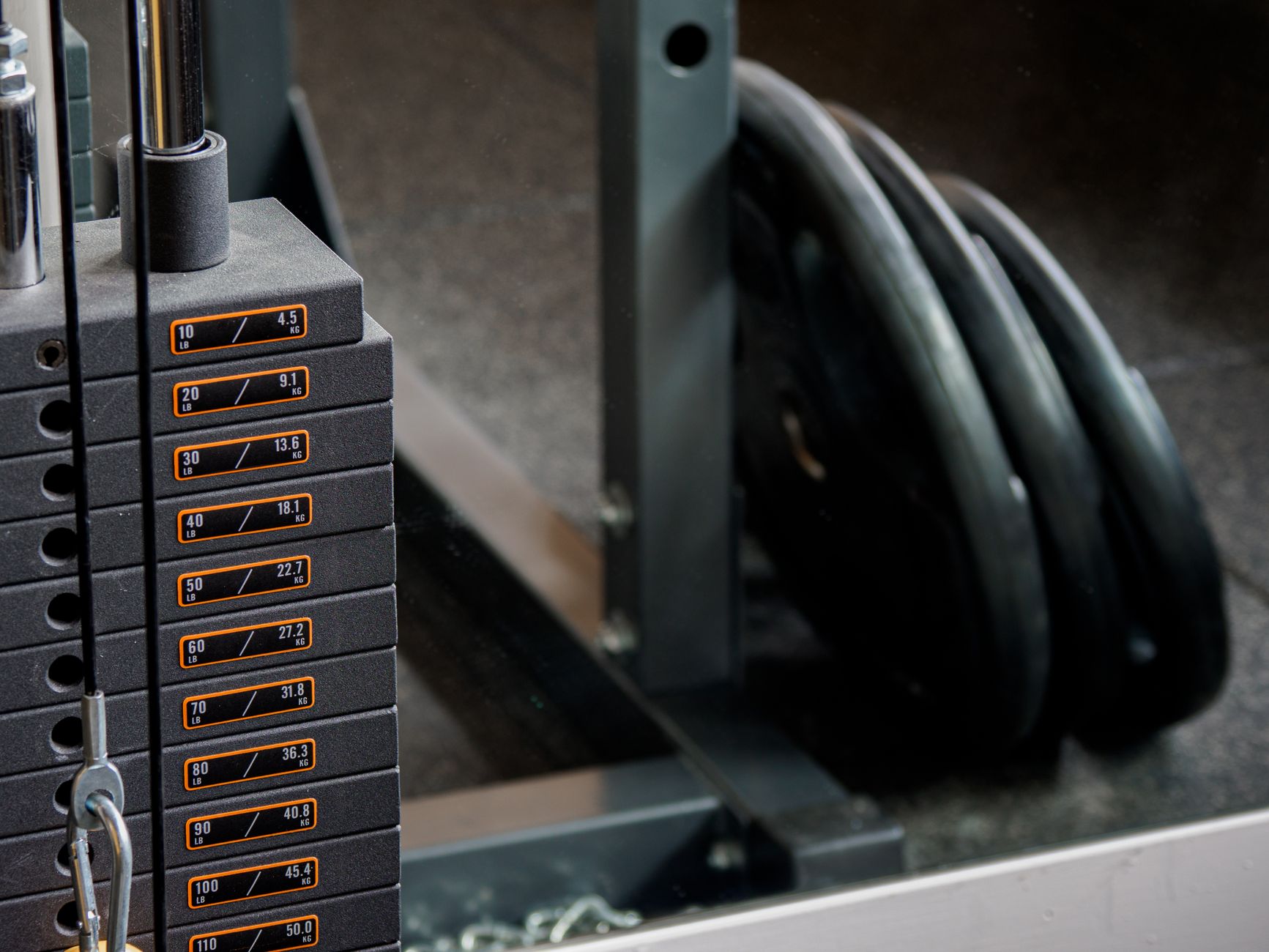
A machine can make steady progress feel impossible: you get comfortable for weeks at one pin, then the next one costs enough reps to turn a controlled set into a grind. The answer is not to guess whether you are "strong enough" for the jump. Use reps to earn the next load, use effort to decide when to test it, and let your reps drop temporarily when you move up.
The key is comparing your performance on the same machine, with the same setup. A stack label is a useful record, not a universal measure of resistance.
Why machine weight increments can feel too large
A 10-pound change on the stack does not always mean 10 pounds more at the handle. Some machines route the cable over pulleys that change the force you feel; others use a shaped wheel that changes resistance through the movement. Labels and designs vary, so a 70-pound setting on one machine is not a reliable comparison with 70 pounds on another.
Even on the same machine, a different seat position, grip, range of motion or rest between sets can change the result. Keep those details consistent before deciding that a pin jump is the reason your reps changed. Use the same machine and setup, and compare like with like.
This is a practical way to apply progressive overload (gradually asking the same movement for more work over time). The extra work can be more clean reps at the current pin before it has to be more weight.
Set a rep target and an effort cap
Choose a range you can use with controlled technique, such as 8 to 12 reps. Keep that range for the exercise long enough to see a trend instead of changing the target every workout. For a set of 3 work sets (the planned sets after warm-ups), record the reps you complete at each set, not just the best set.
Give yourself an effort limit too. RPE (rating of perceived exertion: a 10-point effort scale, where 8 usually leaves about two clean reps) helps describe how hard a set felt. On a machine, you can stop a set while your reps still look the same, rather than grinding through shortened or bounced reps to hit a number. Around RPE 8 is a useful ceiling for building reps; you do not need to reach failure to prove a set counted.
For example, if your target is 3 sets of 8 to 12 at 70 pounds, a session might be 10, 10, 9. Keep 70 pounds next time and try to add a rep where you can, without exceeding your effort limit. Progress does not have to show up on every set at once.
Use reps to bridge the stack jump
Suppose the next pin takes you from 70 to 85 pounds. That is a 21% increase on the label, large enough to cost several reps. At 70, work toward 3 sets of 12 with clean reps and effort no harder than about RPE 8. Reach that target in two sessions before testing 85. Repeating it helps show that the result was not just an unusually good day.
Then try 85 pounds for your first set. If you can get at least 8 controlled reps without pushing past about RPE 9, keep that set at 85. You can do the remaining sets at 70 and build them back up. In later sessions, move another set to 85 when the first one feels steady. Eventually, you will have all your planned sets at the new pin.
That short-term mix of loads is not a failure to progress. It is a way to make the transition in stages. Record the weight and reps you actually did for every set. If 85 pounds gives you fewer than 8 clean reps, or makes you shorten the movement, return to 70 and keep building reps before testing again.
Try a wider rep range when the jump is still too steep
If the next pin is too heavy even after you reach 12 reps, you have two reasonable options. First, widen the range, perhaps to 8 to 15 reps, and keep adding clean reps at the current load. Higher-rep sets can be demanding, so stop when technique starts to change rather than extending the set just to reach 15.
Second, check whether the machine allows a manufacturer-approved add-on weight designed for that stack. Do not improvise by hanging loose weights or placing anything where it could slip, catch a cable or interfere with the machine. If there is no safe intermediate option, stay with the rep approach or use the staged transition: one set at the new pin, then the rest at the old one.
Do not switch to a different machine just because its numbers look friendlier and assume the load is equivalent. If you do change machines, treat it as a new baseline and start tracking its own reps and settings.
Log what happened, not what you planned
A plan might say 85 pounds, but if you did one set at 85 and two at 70, those are the numbers to keep. That record makes it clear whether you are adding reps at the old pin, moving sets to the new one, or repeating the same performance. Keep your rest period reasonably consistent too; rushing one session can make the same load feel much harder.
GymLog logs the weight and reps for each set and offers optional RPE ratings of 7, 8 or 9. Enter the load you actually used on each set, then compare sessions on the same machine and setup. If you prefer a more detailed cue, jot it in your own training notes rather than assuming it is part of the app log.
Know when not to force the next pin
A missed rep target is information, not a cue to heave the stack through a shorter range. Hold the current load if your reps fall below your chosen range, your technique changes, or the new pin brings sharp or unusual pain. Pain is a reason to stop and reassess, not to test your effort rating.
If the same target feels harder for a few sessions, keep the load steady and look at the basics: are you using the same setup, taking similar rest, and arriving recovered enough to perform? There is no prize for adding a pin on a particular calendar date. The useful comparison is whether your clean reps and effort improve over time.
A simple rule for your next workout
Pick a rep range, keep the setup consistent and add reps at the current pin until all planned sets reach the top of the range at controlled effort in two sessions. Test the next pin with one set. If you can meet the bottom of the range cleanly, build more sets there over time; if not, return to the old pin and keep bridging with reps.
That gives you a clear answer to the question the stack cannot answer for you: not whether you are ready based on a feeling, but whether your log shows enough clean work to make the next jump a sensible test.